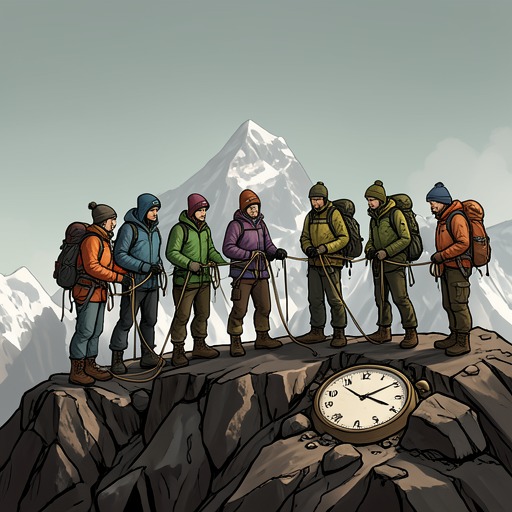
One shot, no more
The Climb“One shot, no more” was the blunt limit placed on Mountain Madness’s 1996 Everest summit plan: the team would make its bid on May 10 or not at all. The phrase captures how a commercial expedition’s fixed schedule and finite oxygen supply narrowed the climbers’ options before they left Camp IV, turning a summit date into a one-way commitment rather than one attempt among several.
The decision behind the phrase
A few days before the summit push, Charlotte Fox and Tim Madsen told another expedition member they were concerned about attempting the climb without proper acclimatization. They had broken the acclimatization routine and had not spent a night at Camp III. The colleague advised them to tell Scott Fischer they wanted to wait until they were acclimatized before making their attempt. They did so, but Fischer replied that the expedition was not organized to make two attempts: it would make only one. The decision surprised the climbers, one of whom recalled thinking that the advertising had not suggested a single try was all they were paying for.
Anatoli Boukreev did not know of Fox and Madsen’s private concern or of their conversation with Fischer. He had already worried that they were ascending without completing the acclimatization schedule, and thought climbers nearing the final push might conceal problems rather than admit they were unwell. The phrase therefore refers not simply to a date on the expedition calendar, but to a policy that left little room to respond to a climber’s need to wait.
The material limit on another attempt
The one-attempt policy was reinforced by the oxygen plan. The six climbing Sherpas took twenty-one bottles from Camp IV; the clients and guides carried seventeen, for a total of thirty-eight Poisk canisters. Fifteen full Poisk canisters remained at Camp IV, along with whatever oxygen remained in the Zvesda bottles from the previous night. That margin was judged too slim to support an overnight delay and a second summit bid on May 11. In the account’s concise formulation, May 10 was the only opportunity.
The plan depended on favorable conditions and carefully calculated consumption. Henry Todd, the oxygen supplier, estimated that a Poisk canister used at two to two and one-half liters per minute would last six hours. Two bottles, he advised, should provide twelve hours: enough, on paper, to reach the summit from Camp IV and descend to the South Summit, where climbers were to collect a third cached bottle. If the climbers reached the summit in the expected ten to eleven hours, they could have one or two hours of oxygen left; the cached supply was then meant to carry them back to Camp IV. Those calculations described a route through the day, not a reserve for repeating it.
Meaning in the account
“One shot, no more” makes the expedition’s constraint sound both practical and absolute. The oxygen count and the predetermined summit date explain why a second attempt was not available; Fox and Madsen’s concerns show what that restriction meant for climbers who felt they were not ready. The phrase’s echo in “May 10 or not at all” compresses the tension between the advertised promise of a guided summit bid and the narrow operational margin beneath it. A single attempt was not merely a slogan: it was the condition under which the team set out.